One Year of AthleatMD: Reflections from the Founders
This week marks one year since we launched AthleatMD.
Over the past year, we have had the ultimate privilege of working with athletes and families across a wide range of sports, ages, and competitive levels. While every athlete’s story is different, several themes have emerged consistently enough that we feel compelled to share.
The Sports World Still Struggles with, and Stigmatizes, Eating Disorders
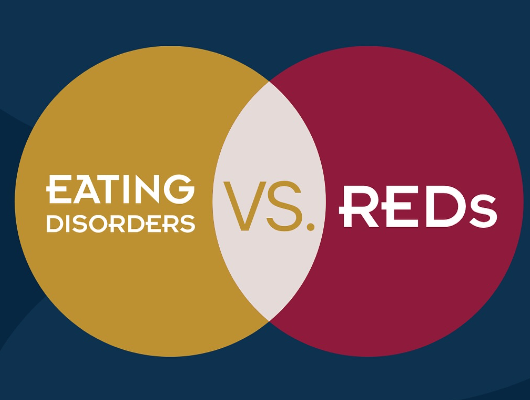
Commonly, an athlete will seek care with us for REDs, or Relative Energy Deficiency in Sport. While many athletes have REDs without an eating disorder, and some have an eating disorder without REDs, there is often overlap and many athletes may meet criteria for both, as in this Venn diagram.
Increasing awareness of REDs in sport communities has been enormously valuable in helping athletes recognize the consequences of underfueling. It has created important entry points for intervention with less stigma. For instance, athletes may feel safe seeking care for REDs, which is a medical diagnosis, but not for anorexia nervosa, which is a psychiatric diagnosis.
Athletes perform at their highest level when sports communities recognize eating disorders as serious health conditions that deserve early identification, compassionate support, and evidence-based treatment. Eating disorders are never a ‘choice’ or reflection of weakness, and left unaddressed, they can profoundly impair health, recovery, resilience, and long-term athletic performance. Creating environments where athletes feel safe seeking help is not only the right thing to do — it is essential for protecting both athlete wellbeing and sustainable performance.
Athletes often struggle with weight restoration (the cornerstone of both REDs and eating disorder treatment)
The research is clear: True physiological recovery requires athletes to return to a state of adequate nourishment, and to fully weight restore. For adolescents, this often means returning to their previous growth (height and weight) trajectory/BMI percentile. For adults, it frequently involves restoring toward their pre-illness weight.
Too often, athletes come to us for help after regaining only the minimum amount of weight needed to “get by” or return to sport. This is reinforced by fear-based messaging from coaches, social media, and sport culture suggesting that increased weight will compromise performance. In reality, chronically underfueled athletes commonly continue to struggle with recurrent injuries, persistent fatigue, impaired recovery, low bone density, GI dysfunction, hormonal disruption, poor adaptation to training, and worsening mental health.
With proper treatment and full weight recovery, we tend to see the opposite of what many athletes fear. Adequately fueled and fully weight-restored athletes are able to train consistently, recover effectively, and perform at their best long term. While recovery takes time, peak performance is built on sustained physiological health.
ARFID Is Profoundly Underrecognized in Athletes
ARFID (Avoidant/Restrictive Food Intake Disorder) is far more common in athletes than many people realize — and especially in youth athletes, where the consequences often significantly impair growth, development, health, and long-term athletic potential.
Unlike more stereotypical eating disorder presentations, athletes with ARFID often do not have body image concerns or a fear of weight gain. Instead, they may have long-standing restrictive or selective eating patterns dating back to early childhood, including low appetite, limited food variety, sensory sensitivities, early satiety, fear of GI discomfort, or extreme “picky eating.” Fear of weight gain is not part of the diagnostic criteria for ARFID.
Because these athletes may not fit traditional assumptions about eating disorders, their symptoms are frequently minimized or misunderstood. In youth sports especially, they are often dismissed as “just picky eaters,” “naturally small,” or “high metabolism kids.”
But during adolescence, when athletes are simultaneously trying to support rapid growth, puberty, bone development, brain development, and increasing training demands, inadequate nutrition can have serious physiologic consequences. We commonly see young athletes struggling with growth suppression, delayed puberty, low energy availability, recurrent injuries, fatigue, anemia, weakness, impaired recovery, hormonal disruption, GI symptoms, and declining athletic performance.
Early recognition matters. The sooner ARFID is identified and appropriately treated, the better the outcomes tend to be for both athletic performance and long-term physical and psychological health.
Athlete Mental Health Is Becoming the Elephant in the Room
Today’s young athletes face more stressors than ever before: the combination of social media exposure, year-round sport specialization, recruiting pressure, transfer portal dynamics, NIL opportunities, and increasingly professionalized youth sports has created a level of psychological pressure that many athletes are simply not developmentally prepared to navigate.
The environment often resembles that of professional sports, but without the infrastructure and support provided by professional sports organizations.
The athletes themselves are often remarkably insightful. Many know they are struggling, but may lack access to the care they need or skills to navigate a complex healthcare system. Mental health support can no longer be viewed as ‘optional’ in athlete care. It is central to both wellbeing and peak performance.
REDs and Eating Disorder Awareness Varies Enormously Across Sports Programs
One of the most striking observations from this year has been the sheer variability in REDs and eating disorder literacy across club and collegiate sports programs.
Some programs are extraordinarily thoughtful and proactive. Coaches, athletic trainers, dietitians, physicians, and mental health professionals communicate well and intervene early. Athletes in these environments often feel genuinely supported.
Others still operate with minimal understanding of REDs physiology, eating disorder risk, or the unintended consequences of certain coaching practices and messaging around body weight and shape. Sometimes the differences exist not just between schools, but between teams within the same institution.
The good news is that awareness is improving. Conversations that rarely happened a decade ago are now occurring openly in many sports spaces. But there is still considerable work ahead.
Looking Forward
This first year has only strengthened our belief that athletes need more — more education around conditions like REDs and eating disorders, more nuanced understanding of the immense pressures they face, and more comprehensive support for their nutrition, health, recovery, and overall well-being.
Too many athletes are still expected to perform at the highest level while struggling silently with underfueling, injury, burnout, disordered eating, and overwhelming physical and psychological stress. Athletes deserve better than a culture that normalizes suffering in the name of performance.
We are profoundly grateful to the athletes, families, coaches, and healthcare providers who have trusted AthleatMD over the past year. It is a privilege to care for this community and to witness the resilience of athletes navigating extraordinarily complex challenges.
There is still significant work ahead. But we remain hopeful that sports culture can evolve into one that is better informed, more compassionate, and ultimately more sustainable for athletes at every level.